
Back and Bicep Workout Plan
This comprehensive plan details effective back and bicep routines, offering four training plans with a downloadable PDF resource.
It’s designed to build muscle and strength,
catering to all fitness levels – from beginner to advanced!
Combining back and bicep training is a classic approach for building upper body strength and aesthetics. These muscle groups complement each other effectively, as a strong back provides the foundation for powerful bicep curls.
A well-structured back and bicep workout PDF can be incredibly valuable, offering pre-designed routines and guidance.
Whether you’re aiming for increased muscle mass, improved posture, or enhanced athletic performance, this pairing delivers results. Remember, proper form and progressive overload are key to maximizing gains and minimizing injury risk.
Utilizing a detailed plan ensures a balanced and effective training experience.
Understanding Back Muscle Anatomy
A successful back workout PDF hinges on understanding the complex back musculature. The back isn’t one muscle, but a network of interconnected groups. Key players include the trapezius, responsible for shoulder movement and posture; the broad latissimus dorsi, creating the “V-taper”; and the rhomboids, crucial for scapular retraction.
Knowing these muscles allows targeted exercise selection. For example, pull-ups primarily engage the lats, while rows work the rhomboids and mid-back. A comprehensive back and bicep workout considers all these areas for balanced development and injury prevention.
Trapezius Muscles
The trapezius muscles, often overlooked in a back and bicep workout PDF, are vital for upper back strength and posture. Spanning from the base of the skull to the mid-back and shoulders, they control scapular movement – elevation, depression, retraction, and rotation.
Exercises like shrugs directly target the traps, building thickness. However, many compound movements, such as rows and pull-ups, also engage them as stabilizers. A well-rounded workout plan includes variations to hit all portions of this muscle group, promoting balanced development and preventing imbalances.
Latissimus Dorsi Muscles
The latissimus dorsi, or “lats,” are the largest muscles in the back, crucial for creating a V-shaped physique – a key goal in many back and bicep workout PDF programs. These muscles extend, adduct, and internally rotate the arm, contributing significantly to pulling strength.
Exercises like pull-ups, lat pulldowns, and various rowing movements are essential for lat development. Focusing on squeezing the shoulder blades together during these exercises maximizes lat engagement. A comprehensive workout plan should incorporate different grips and angles to target all areas of this expansive muscle group effectively.
Rhomboids Muscles
The rhomboids, located between the shoulder blades and spine, play a vital role in posture and scapular retraction – pulling the shoulder blades together. Often overlooked in back and bicep workout PDF routines, strengthening these muscles is crucial for preventing shoulder injuries and improving overall back health.
Exercises like seated cable rows with a focus on squeezing the shoulder blades, and dumbbell rows, effectively target the rhomboids. A well-rounded workout plan should include movements that specifically address rhomboid activation, promoting balanced muscle development and a strong, stable upper back.
Understanding Bicep Muscle Anatomy
Before diving into a back and bicep workout PDF, understanding the biceps’ anatomy is key for targeted training. The biceps brachii, comprising the long and short heads, is the primary flexor of the elbow. However, the biceps aren’t solely responsible for arm size and strength.
The brachialis muscle, lying underneath the biceps, is a pure elbow flexor, contributing significantly to overall arm power. Additionally, the brachioradialis, located on the forearm, assists in elbow flexion and forearm rotation. Effective bicep workouts address all three muscles for complete development.
Biceps Brachii (Long and Short Head)
Within a well-structured back and bicep workout PDF, targeting both heads of the biceps brachii is crucial for balanced development. The long head, originating from the shoulder blade, contributes to peak height, while the short head, originating from the coracoid process, adds width.
Exercises like concentration curls emphasize the long head, while hammer curls activate the brachialis and brachioradialis alongside the short head. Varying grip positions – supinated, neutral, and pronated – during curls ensures comprehensive stimulation of both heads, maximizing muscle growth and definition.
Brachialis Muscle
A comprehensive back and bicep workout PDF shouldn’t neglect the brachialis, a key elbow flexor lying beneath the biceps brachii. Often overlooked, strengthening the brachialis contributes significantly to overall arm size and pushing power. Unlike the biceps, it’s less affected by grip variations, making it responsive to direct stimulation.
Exercises like reverse curls and hammer curls effectively target the brachialis. Focusing on these movements builds a thicker, fuller arm appearance, pushing the biceps upwards and creating the illusion of greater size. Prioritizing the brachialis enhances functional strength and aesthetic appeal.
Brachioradialis Muscle
A well-rounded back and bicep workout PDF must include exercises targeting the brachioradialis, a forearm muscle crucial for elbow flexion and forearm stability. It’s particularly active during semi-pronated grips, like those used in hammer curls. Strengthening this muscle improves grip strength and overall arm functionality.
Exercises such as hammer curls and reverse curls are excellent for isolating the brachioradialis. Developing this muscle not only enhances forearm aesthetics but also contributes to improved performance in pulling exercises, like rows and pull-ups. Don’t underestimate its role in a complete arm development program!
Warm-up Exercises for Back and Biceps
A proper warm-up is essential before any back and bicep workout PDF routine. Begin with 5-10 minutes of light cardio, like jogging or jumping jacks, to increase blood flow to the muscles. This prepares them for exertion and reduces injury risk.
Follow this with dynamic stretching, focusing on movements that mimic the exercises you’ll be performing. Arm circles, torso twists, and shoulder rotations are excellent choices. Prioritizing a thorough warm-up ensures optimal performance and minimizes the chance of strains or pulls during your training session.
Dynamic Stretching for Back
Dynamic stretches for the back prepare muscles for movement, unlike static stretches which are best saved for cool-downs. Incorporate torso twists, gently rotating your upper body from side to side, keeping your core engaged. Cat-cow stretches improve spinal mobility, arching and rounding your back rhythmically.
Arm circles, both forward and backward, warm up the shoulder girdle, crucial for many back exercises. These movements increase blood flow and range of motion, enhancing performance and reducing the risk of injury during your back and bicep workout PDF session.
Light Cardio for Blood Flow
Prior to resistance training, light cardio is essential for increasing blood flow to the muscles, preparing them for exertion. Five to ten minutes of low-intensity activity, such as jogging on the spot, jumping jacks, or brisk walking, will suffice.
This elevated blood flow delivers vital oxygen and nutrients to the back and biceps, enhancing muscle performance and reducing the likelihood of cramping. A warmed-up circulatory system also improves muscle elasticity, contributing to a safer and more effective back and bicep workout PDF experience.
Back Exercises
A robust back workout is fundamental for overall strength and posture. Key exercises include pull-ups, offering variations for different skill levels and progression options. Barbell rows, performed with proper form, target the entire back musculature.

Dumbbell rows, both single-arm and chest-supported, allow for focused muscle activation. Lat pulldowns, utilizing varied grips, effectively work the lats. Finally, seated cable rows emphasize the squeezing motion for optimal back development, all crucial components of a comprehensive back and bicep workout PDF.
Pull-Ups (Variations & Progression)
Pull-ups are a cornerstone of back development, demanding significant strength and coordination. For beginners, assisted pull-ups using resistance bands or an assisted pull-up machine are excellent starting points. Progress to negative pull-ups, focusing on controlled descent.
As strength increases, attempt unassisted pull-ups, varying grip width (wide, narrow, neutral) to target different back muscles. Incorporate weighted pull-ups for advanced training, adding a weight belt or vest. Consistent practice and progressive overload are key to mastering this challenging, yet rewarding, exercise within your back and bicep workout PDF.
Barbell Rows (Form and Technique)

Barbell rows are a powerful compound exercise for building overall back strength and thickness. Maintain a flat back, hinge at the hips, and keep the core engaged throughout the movement. Grip the barbell slightly wider than shoulder-width apart, palms facing down.
Pull the barbell towards your lower abdomen, squeezing your shoulder blades together. Control the eccentric phase, slowly lowering the weight. Proper form is crucial to prevent injury; prioritize technique over lifting heavy weight. This exercise is a staple in any effective back and bicep workout PDF.

Dumbbell Rows (Single Arm & Chest Supported)
Dumbbell rows offer versatility, allowing for both single-arm and chest-supported variations. Single-arm rows enhance core stability, requiring you to brace against rotation. Chest-supported rows isolate the back muscles, minimizing cheating.
Maintain a neutral spine and pull the dumbbell towards your ribcage, focusing on squeezing the shoulder blades. Control the descent for optimal muscle engagement. These exercises are excellent additions to a back and bicep workout PDF, providing targeted back development. Varying between these techniques maximizes muscle fiber recruitment.
Lat Pulldowns (Grip Variations)
Lat pulldowns are a staple for building a wider back, and grip variations significantly impact muscle activation. Wide-grip pulldowns emphasize the upper lats, creating breadth. Close-grip, underhand pulldowns target the lower lats and biceps more directly.
Neutral-grip pulldowns offer a balanced approach. Focus on pulling with your elbows, squeezing your shoulder blades together, and controlling the eccentric phase. Incorporating these grip changes into your back and bicep workout PDF ensures comprehensive lat development and prevents plateaus. Experiment to find what feels best!
Seated Cable Rows (Focus on Squeeze)
Seated cable rows are excellent for developing back thickness and strength. Maintaining proper form is crucial; sit with your back straight and core engaged. Pull the handle towards your lower abdomen, focusing on squeezing your shoulder blades together.
Avoid rounding your back or using momentum. Different handle attachments – wide, close, V-bar – target slightly different muscle fibers. Include this exercise in your back and bicep workout PDF, prioritizing the squeeze at the peak contraction for maximum muscle engagement and growth. Control the return for a full range of motion.
Bicep Exercises
Bicep exercises are vital for upper body aesthetics and functional strength. A well-rounded routine incorporates variations to target all bicep heads. Barbell curls build mass, while dumbbell curls – hammer, concentration, and alternating – offer versatility.
Cable curls provide constant tension throughout the movement, maximizing muscle fiber recruitment. Preacher curls isolate the biceps, minimizing cheating. Include these in your back and bicep workout PDF, emphasizing proper form to prevent injury and optimize results. Vary grip and rep ranges for comprehensive development.
Barbell Curls (Proper Form)
Barbell curls are a cornerstone of bicep training, building significant mass. Maintain a straight back, core engaged, and elbows tucked to your sides. Grip the barbell shoulder-width apart, palms facing forward. Curl the weight up, focusing on contracting the biceps, avoiding swinging or using momentum.
Lower the weight slowly and with control. Proper form is crucial; avoid rounding your back or letting your elbows drift forward. Include this detailed form guide in your back and bicep workout PDF. Aim for controlled movements and a full range of motion for optimal results.
Dumbbell Curls (Hammer, Concentration, & Alternating)
Dumbbell curls offer versatility for targeting biceps from different angles. Hammer curls, with palms facing each other, emphasize the brachialis and brachioradialis. Concentration curls, performed seated with the elbow braced, isolate the biceps for peak contraction.
Alternating dumbbell curls allow for focused effort on each arm. Include detailed instructions and images of each variation in your back and bicep workout PDF. Prioritize controlled movements and a full range of motion. These variations enhance muscle development and prevent plateaus.
Cable Curls (Constant Tension)
Cable curls provide constant tension throughout the entire range of motion, maximizing muscle fiber recruitment. This differs from free weight curls, where tension fluctuates. Utilize a low pulley station and a straight or angled bar attachment. Maintain a stable core and avoid swinging your body to generate momentum.
Include clear instructions and visual aids in your back and bicep workout PDF. Focus on squeezing the biceps at the peak contraction and controlling the eccentric phase. Cable curls are excellent for building muscle endurance and definition.
Preacher Curls (Isolation)
Preacher curls are a fantastic isolation exercise for the biceps, minimizing cheating and maximizing muscle activation. The preacher bench supports your upper arms, preventing momentum and forcing the biceps to do all the work. Use a barbell or dumbbells, maintaining a controlled descent and explosive concentric contraction.
Your back and bicep workout PDF should emphasize proper form – keep your upper arms stationary and focus on a full range of motion. Preacher curls are ideal for targeting the biceps peak and enhancing muscle definition.
Workout Routine 1: Beginner Back & Bicep
This beginner routine focuses on building a foundation of strength and proper form. Your back and bicep workout PDF should include 3 sets of 10-12 repetitions for each exercise. Select exercises like assisted pull-ups, dumbbell rows, and lat pulldowns for back, and dumbbell curls, hammer curls, and cable curls for biceps.
Prioritize controlled movements and focus on feeling the muscles work. Rest for 60-90 seconds between sets. This routine is designed to introduce you to the fundamental exercises and prepare you for more advanced training.
Sets and Reps for Beginners
Beginners should aim for 3 sets of 10-12 repetitions for each back and bicep exercise, as outlined in your workout PDF. This rep range promotes muscle endurance and helps establish proper form. Focus on completing each set with controlled movements, prioritizing technique over lifting heavy weight.
Rest periods should be between 60-90 seconds to allow for adequate recovery between sets. Gradually increase the weight as you become stronger, maintaining good form throughout. Consistency is key – aim for 2-3 beginner workouts per week.
Exercise Selection for Beginners
For beginners, prioritize foundational movements detailed in the back and bicep workout PDF. Start with assisted pull-ups (using a band or machine), dumbbell rows, and lat pulldowns with a wide grip. These exercises build a solid base of strength.
For biceps, focus on dumbbell curls, hammer curls, and cable curls with lighter weights. Avoid complex variations initially. Proper form is crucial; watch instructional videos and consider working with a trainer; This selection minimizes risk and maximizes muscle activation for newcomers.
Workout Routine 2: Intermediate Back & Bicep

This intermediate routine, found within the back and bicep workout PDF, builds upon the beginner foundation. Perform 3-4 sets of 8-12 repetitions for each exercise. Include pull-ups (aim for unassisted), barbell rows, and chest-supported dumbbell rows. Introduce variations like close-grip lat pulldowns.
For biceps, incorporate barbell curls, alternating dumbbell curls, and concentration curls. Focus on controlled movements and a full range of motion. Increase weight gradually while maintaining proper form. This routine challenges muscles further, promoting continued growth and strength gains.
Sets and Reps for Intermediate Level
The intermediate back and bicep workout PDF recommends a structure of 3 to 4 sets per exercise, targeting a repetition range of 8 to 12 reps. This range balances strength and hypertrophy – muscle growth. Prioritize controlled movements over lifting heavy weight with poor form.
Rest periods should be between 60-90 seconds between sets, allowing for adequate recovery. Adjust weight to ensure you reach muscle failure within the target rep range. Progressive overload – gradually increasing weight – is crucial for continued progress. Listen to your body and adjust as needed.

Exercise Selection for Intermediate Level
The intermediate PDF workout plan incorporates a blend of compound and isolation exercises. For back, include barbell rows, dumbbell rows (single arm and chest-supported), lat pulldowns with varied grips, and seated cable rows focusing on a strong squeeze.
For biceps, incorporate barbell curls with proper form, dumbbell curls (hammer, concentration, and alternating), and cable curls for constant tension. Consider adding preacher curls for focused bicep isolation. This selection promotes balanced muscle development and addresses different muscle fibers within the back and biceps.
Workout Routine 3: Advanced Back & Bicep
The advanced PDF workout routine demands high intensity and volume. Expect 4-5 sets of 6-10 repetitions for most exercises. Incorporate advanced techniques like drop sets, supersets, and negatives. Back exercises include weighted pull-ups, barbell rows with heavier weight, and challenging lat pulldown variations.
Bicep work features heavier barbell curls, concentration curls with slow negatives, and cable curls utilizing different attachments. Prioritize perfect form to prevent injury. This routine is designed for experienced lifters seeking significant muscle growth and strength gains.
Sets and Reps for Advanced Level
For advanced lifters, a focus on maximizing muscle hypertrophy is key. Implement 4-5 sets per exercise, aiming for a rep range of 6-10 for compound back movements like barbell rows and weighted pull-ups. Isolation exercises, such as concentration curls, can utilize 3-4 sets of 8-12 reps.
Incorporate drop sets and supersets to increase intensity and time under tension. Rest periods should be concise, around 60-90 seconds, to maintain metabolic stress. Prioritize progressive overload by consistently increasing weight or reps each workout.
Exercise Selection for Advanced Level
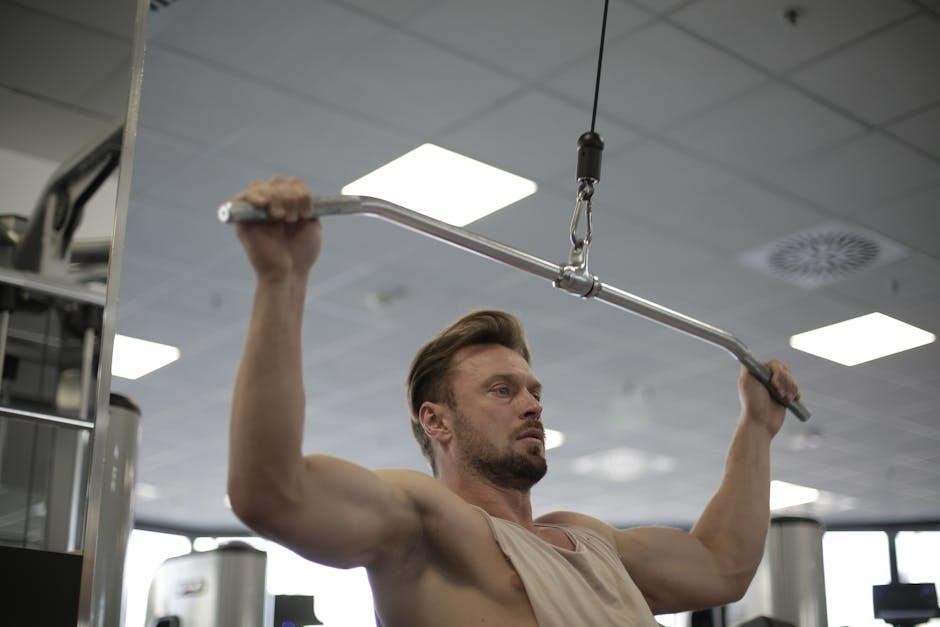
Advanced athletes should prioritize complex, multi-joint movements. Include weighted pull-ups, barbell rows (Pendlay or Yates), and T-bar rows to build a thick back. For biceps, incorporate variations like preacher curls with a cambered bar, and spider curls for peak contraction.
Introduce unilateral exercises like dumbbell rows and single-arm lat pulldowns to address imbalances. Consider incorporating advanced techniques like eccentric training and rest-pause sets. Don’t shy away from challenging variations to continually stimulate muscle growth and prevent plateaus.
Cool-down and Stretching
A proper cool-down is crucial for recovery and flexibility. Begin with 5-10 minutes of light cardio, like walking, to gradually lower your heart rate. Follow this with static stretching, holding each stretch for 30 seconds.
For back muscles, focus on stretches like cat-cow, child’s pose, and torso twists. For biceps, gently stretch by extending your arm and rotating your palm upwards. Consistent stretching improves range of motion, reduces muscle soreness, and prevents injuries. Prioritize these steps after every back and bicep session!

Static Stretching for Back Muscles
Effective static stretches for your back include the seated spinal twist, holding for 30 seconds per side to improve spinal mobility. The cat-cow stretch gently articulates the spine, relieving tension. Child’s pose offers a deep stretch for the lower back and shoulders.

Additionally, perform a lying knee-to-chest stretch, pulling one knee at a time towards your chest. Remember to breathe deeply throughout each stretch, avoiding any bouncing movements. These stretches enhance flexibility, reduce muscle soreness, and promote long-term back health after your workout.
Static Stretching for Bicep Muscles
To effectively stretch your biceps, begin with a triceps stretch, extending one arm overhead and bending at the elbow, gently pulling the elbow towards your head with the opposite hand. Then, perform a cross-body shoulder stretch, bringing one arm across your body and holding it with the other.
A simple bicep stretch involves extending your arm straight and gently pressing the palm towards your body. Hold each stretch for 20-30 seconds, focusing on deep breaths. These stretches improve flexibility, reduce post-workout soreness, and enhance overall arm muscle recovery.
Importance of Proper Form
Maintaining correct form is paramount during back and bicep exercises to prevent injuries and maximize results. Prioritize controlled movements over lifting heavy weights. A rounded back during rows or curls can lead to strains, while improper grip can compromise muscle engagement.
Focus on engaging the target muscles throughout each repetition. Watch videos, use mirrors, or seek guidance from a trainer to refine your technique. Proper form ensures that you’re effectively working the intended muscle groups and minimizing the risk of long-term physical issues.
Nutrition for Muscle Growth
Fueling your body with the right nutrients is crucial for back and bicep muscle growth; Prioritize a diet rich in protein, consuming approximately 0.8-1 gram per pound of body weight daily. Complex carbohydrates provide sustained energy for workouts, while healthy fats support hormone production.
Don’t underestimate the importance of hydration; water is essential for muscle function and recovery. Consider supplementing with creatine to enhance strength and power. Timing your nutrient intake around workouts – pre and post-exercise – optimizes muscle protein synthesis and recovery.
Recovery and Rest
Adequate recovery is as vital as the workout itself for back and bicep muscle growth and preventing injury. Aim for 7-9 hours of quality sleep each night to allow your body to repair and rebuild muscle tissue. Incorporate active recovery days, such as light cardio or stretching, to improve blood flow and reduce muscle soreness.
Listen to your body and don’t push through pain. Proper rest days between workouts targeting the same muscle groups are essential. Consider techniques like foam rolling and massage to alleviate muscle tension and enhance recovery. Prioritizing recovery maximizes your training gains!

Creating a PDF Workout Plan
To maximize convenience, compile your chosen workout routine into a portable PDF document. Utilize word processing software or dedicated fitness app features to structure your sets, reps, and exercises clearly. Include warm-up and cool-down routines for a complete plan.
Adding visual aids, like exercise demonstrations, enhances understanding. Save the document as a PDF to ensure consistent formatting across devices. This allows easy access during workouts, whether at the gym or at home, promoting adherence to your back and bicep training program!